

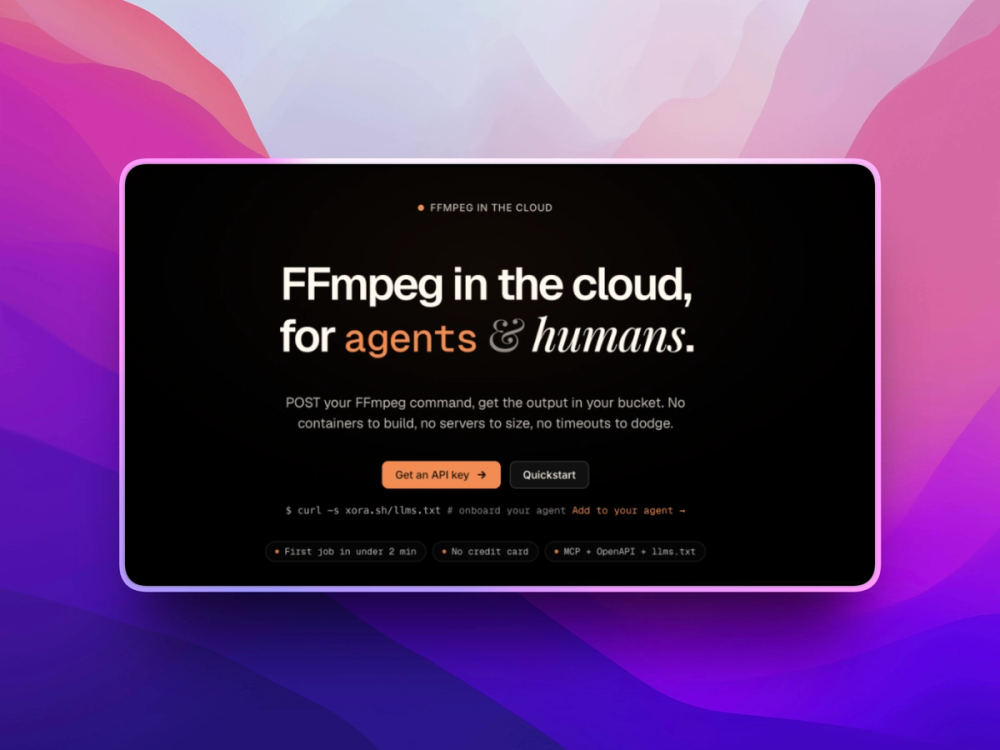
Xora is a cloud FFmpeg API built for developers, automation workflows, and AI agents. It lets applications run familiar FFmpeg commands or reusable media-processing recipes through a REST endpoint, while handling jobs, infrastructure, scaling, storage, and asynchronous processing.
Key Features
-
Raw FFmpeg Commands: Run standard FFmpeg arguments through a JSON API without managing binaries, containers, queues, or transcoding servers.
-
Recipes & Presets: Use ready-made workflows for compression, thumbnails, trimming, concatenation, audio extraction, and web-ready video processing.
-
Agent-Ready Interfaces: Connect through REST, OpenAPI, llms.txt, or a remote MCP server with structured inputs, outputs, errors, and job states.
-
Asynchronous Jobs: Track queued, transcoding, completed, failed, rejected, and cancelled jobs through polling or webhooks.
-
Idempotent Processing: Use idempotency keys to make retries safer and prevent duplicate processing when jobs are resubmitted.
-
Flexible Storage: Accept media inputs from HTTPS URLs and deliver finished files through signed download URLs or directly to Cloudflare R2.
-
Scalable Processing: Process long-running or high-volume media jobs using isolated workers and parallel processing without serverless timeout limitations.
Benefits
-
Faster Development: Add production-ready media processing without building and maintaining dedicated FFmpeg infrastructure.
-
Full FFmpeg Control: Continue using familiar codecs, flags, filter graphs, and multi-input commands without being limited by a simplified abstraction.
-
Reliable Automation: Use structured job states, parseable errors, webhooks, and idempotent retries to make applications and AI agents respond predictably.
-
Reduced Infrastructure Work: Let Xora handle compute, workers, storage, concurrency, and scaling instead of maintaining your own transcoding infrastructure.
-
AI Agent Ready: Give AI agents and automation systems structured access to media-processing capabilities through REST and MCP interfaces.
-
Flexible Scaling: Handle everything from individual media conversions to long-running and high-volume processing workloads.


